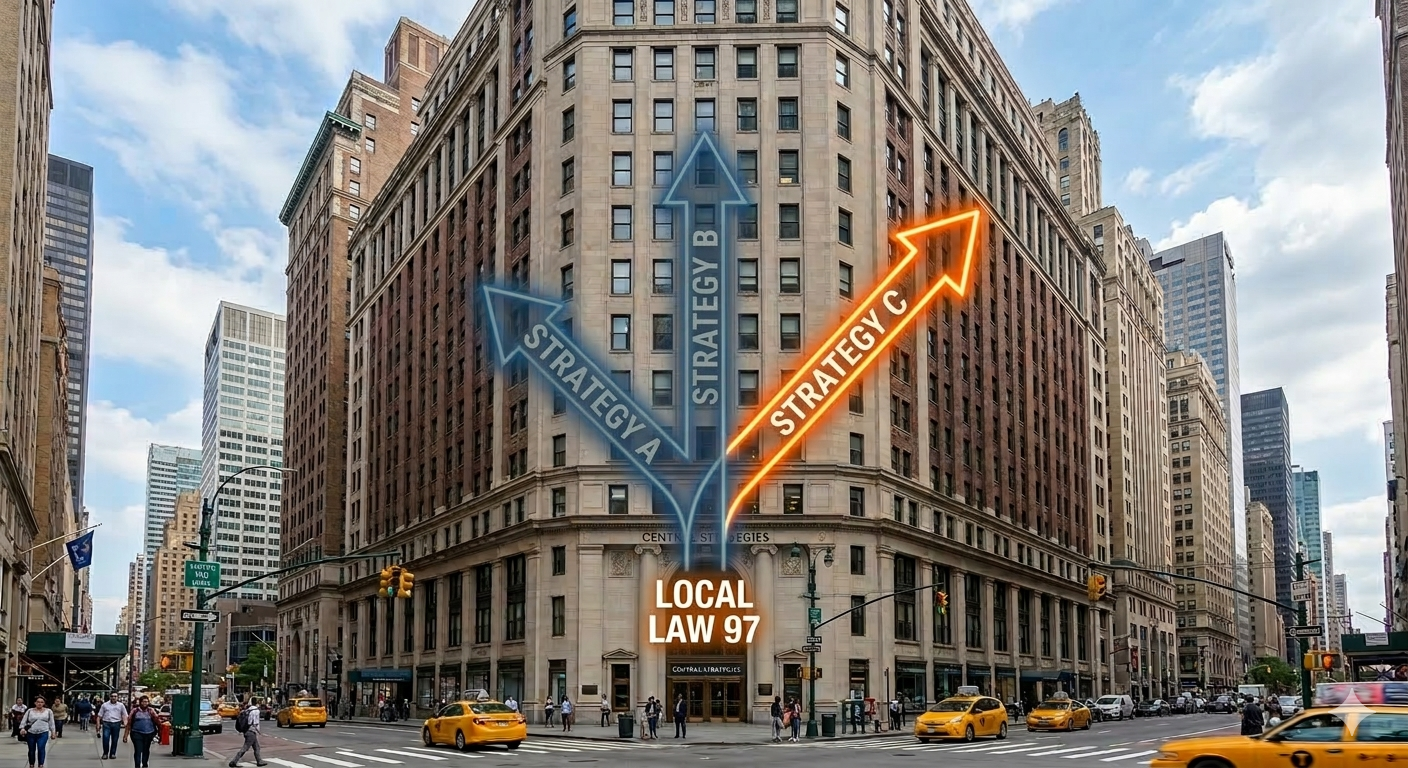

What Happens If a Building Doesn’t Comply with NYC Energy Laws? Understanding the Real Consequences

Did you know that in New York City over two-thirds of greenhouse gas emissions (that’s 47.9 Million Tonnes CO2e according to the Urban Green Council) come from buildings? Because of this outsized impact, over the last two decades, New York City has introduced a variety of climate-oriented local laws that focus on building sector emissions. Particularly, most large buildings over 25,000 square feet fall under Local Law 97 (LL97), which came into effect in 2024 and will become stricter in 2030 and beyond.

[Want to learn more about LL97? Read our blog posts on energy law compliance basics and strategies for energy law compliance here.]

Failure to meet the emissions caps set in LL97 will result in severe financial penalties. But beyond the fines for this and other local laws, non-compliance may lead to more costs for your building: from loss of eligibility for city and state financial incentives to higher carbon emissions to quality of life impacts on your tenants/shareholders.

As your building moves towards compliance, you may be wondering: What happens if we don’t take action in a timely fashion? 

Here’s what you should know about complying with NYC energy laws:

How the Penalties Work

Penalties for non-compliance are formula based and structured, with clear guidelines available on the NYC Buildings website.

For instance, for LL97, NYC code states that for buildings subject to Article 320 (which defines the covered buildings; e.g. most large private buildings over 25,000 gross square feet):

  • A covered building owner must submit the annual building emissions report
    • Penalty for non-compliance = (Floor Area x $0.50) per month
  • A covered building must meet the annual emissions limit for that building
    • Penalty for non-compliance = ((Actual Emissions – Emissions Limit) x $268) per year

For buildings subject to Article 321 (which provides alternative pathways for specific types of buildings, includes affordable housing and houses of worship):

  • A covered building owner must submit the compliance report on time
    • Penalty for non-compliance = $10,000
  • A covered building must demonstrate compliance with one of the two compliance pathways
    • Penalty for non-compliance = $10,000

Building owners should review the rules and may submit requests to the Department of Buildings (DOB) for adjustments based on external and financial constraints, as well as take advantage of deductions and alternatives.

Why the Penalties Drive Action

For LL97, NYC Accelerator notes that an estimated 11% of buildings are expected to exceed their caps in this first phase (2024–2029), and that the stricter limits in the next period (2030–2034) would affect up to 63% of covered buildings if no efficiency upgrades were made.

In other words: The penalties are designed to be costly enough to drive buildings to make investments in efficiency upgrades.

[Learn more about strategies for upgrades here.]

How NYC Energy Laws Are Enforced

Enforcement for these types of laws typically happens through administrative compliance and financial penalties, rather than physical enforcement actions.

Although we have not yet seen how NYC will enforce LL97 in practice (since the first final extended deadline was December 31, 2025), we know NYC is expecting buildings that fall under the law to file—and if they have calculated penalties, to develop an emissions plan or alternative pathways to meet future compliance.

Concerned about compliance? Based on our experience, we believe that the city will look to negotiate and/or find a mediated resolution with buildings to ensure action. We recommend buildings work with an experienced consultant to guide them in this process to demonstrate action to the DOB.

The takeaway: Even if your building is facing penalties, we recommend working with an expert to develop a plan for taking action, so that you can mitigate your fines and long-term costs. Furthermore, working with an expert can help you to uncover rebates and incentives that may offset your long-term investments into upgrade work.

[Learn more about our rebate & incentives services.]

How Penalties Compound Over Time

Let’s take a look at an example of a building that exceeds its LL97 limits by 500 metric tons. Based on the penalty structure above, that building would face roughly $134,000 annually in penalties in the short term if no investments in efficiency upgrades are taken.

In addition, these emissions penalties would increase over time, because stricter limits will come into effect in 2030, 2035, and beyond. While we don’t  yet know what those newer penalty structures will look like, we do know that they will likely be more severe over time to force compliance.

Thinking Ahead to 2030

Michael Scorrano, PE, Managing Director and Founder, EN-POWER GROUP

Beyond immediate penalties, Michael Scorrano, PE, Managing Director and Founder of EN‑POWER GROUP, cautions that buildings must think ahead. He explains that while those buildings that are fined in the first phase may take action immediately, “Many people impacted by the second compliance phase starting in 2030 are sitting there saying, ‘We know we may have to do something in the future, but we’re not necessarily thinking about it in 2026. Maybe 2027/28 we’ll get serious and do something.’”

Scorrano warns that putting off work may be problematic, as it may take several years to get work completed in time for the 2030 phase. Therefore, it’s imperative that buildings start planning now in order to be ready for 2030 and beyond.

What Non-Compliance Means for Building Operations and Residents/Tenants

Compliance isn’t just a technical issue: It’s one that impacts both building operations and residents/tenants.

Impact on Building Operations

In addition to budgeting to pay the penalties on an annual and increasing basis, non-compliance may impact a building’s operations in other ways. Scorrano says, “People might think about this as just short-term pain, but there are obviously longer-term benefits and implications to investing in efficiency upgrades.”

He emphasizes that energy efficiencies today pay dividends tomorrow, as energy continues to become more expensive over time, “If you look at a lifecycle cost, the savings could be worth millions and millions of dollars over a 25-year period. Energy efficiency and decarbonization plans in the building could help to provide long-term energy savings.”

Impact on Residents/Tenants

For residents/tenants, non-compliance drives up their monthly costs, may impact the quality of their comfort/experience in the building (as compared to buildings that implement measures to meet their carbon caps), and may impact their ability to sell their units (when applicable) due to prospective buyers’ perceptions about the building’s efficiency, energy usage, and utility costs.

Translation: The impact of non-compliance goes well beyond fines.

Reporting, Disclosure, and Transparency

Collective data from LL97 and laws like it allow the government to better understand how building emissions are changing over time. Data published by the government, as well as organizations like the Urban Green Council, show the impact of compliance, as well as potential for impact.

Why the Timeline Matters

As discussed above, LL97 and other similar laws are designed to become more stringent over time, so it’s important for building owners to plan ahead and build a roadmap towards increasing efficiency.

Key milestones include:

  • 2024–2029: Initial compliance period
  • 2030–2034: Stricter limits come into effect (including lower electricity carbon coefficient and 40% targets for New York City Housing Authority)
  • 2035-2049: More stringent limits come into effect
  • 2050+: Citywide zero emissions requirements come into effect

While the timelines and limits may shift as new city administrations come into power, the milestones should still be used as a starting point for planning for building owners.

[Learn more on the NYC Buildings website.]

Recap: Plan Ahead to Maximize Benefits and Minimize Penalties

What happens if your building does not take action to comply with NYC energy laws? In addition to facing annual penalties in the short-term—and increased penalties at future compliance milestones—your building will not be able to take advantage of the financial incentives that may be available currently, nor will your building benefit from the real-world cost savings of energy efficiency.

Scorrano sums it up: “Time goes fast and it’s really important for buildings to at least start resource planning in order to (A) hire a consultant to help put together a good roadmap and (B) look at their capital reserve requirements. It really is the type of thing where you need to start now in order to really plan for 2030. Even if you don’t put a project in action this year, or even into next year, you certainly need to have something going on by 2028 in order to meet your 2030 requirement, if you have a big carbon penalty. The sooner you can get something done, the quicker you may get a benefit from the energy efficiency standpoint.”


If you need support complying with LL97 and other NYC energy laws, get in touch with us, and our team can work with you to build a plan. Reach out at 914-263-1199 or email info@enpg.com.

Or, contact our Director of Business Development, Mitchell Karasik, with your building address and contact name, and we’ll be in touch fast:

📧 mvkarasik@enpg.com

📞 914-263-1199
How Local Law 97 Compliance Actually Starts: The Conversations Most Buildings Aren’t Having

How Local Law 97 Compliance Actually Starts: The Conversations Most Buildings Aren’t Having 

By Mitchell Karasik 

I am out talking to building owners, developers and property managers every day, and clearly right now Local Law 97 (LL97) is dominating these conversations. For every building that’s well on its way to 2030 compliance, there is one that is taking its first steps.  

Regardless of where a building is in its journey, there is one constant: at some point, you will have to be in compliance. You can get a head start and have a smoother journey, or you can wait and risk limited, and often more expensive, options, or much worse, end up with a large penalty. 

When people talk about Local Law 97 compliance, they usually focus on engineering. But in practice, building compliance doesn’t start with equipment decisions. It starts with conversations. 

I say, let’s talk.  

For most buildings, the first step toward Local Law 97 compliance planning is simply realizing the building is due. That realization usually happens when a property manager, board member, or owner learns their building appears on a compliance list or is approaching a required filing year. 

At that point, the conversation shifts quickly from awareness to logistics: 

  • What do we need to file? 
  • Who handles it? 
  • What does this mean for our building? 
  • What is this going to cost?  

Those early conversations are where most NYC building compliance strategy really begins. 


It’s A Complex Conversation, Regardless of Where You Start 

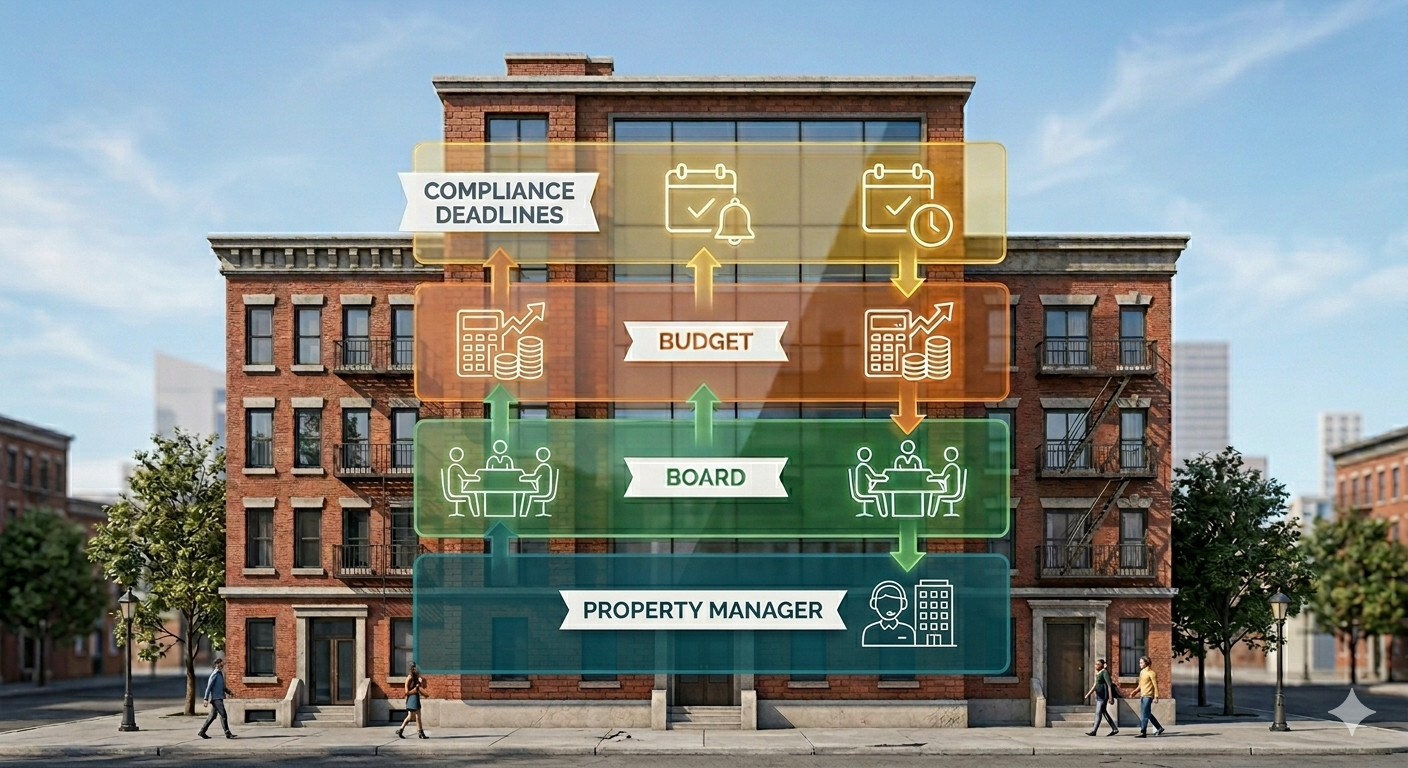
So, who is having these conversations? Well, that depends on what kind of building we are talking about. In multifamily buildings, the compliance conversation almost always starts with the property manager. 

Property managers typically oversee multiple buildings and serve as the operational hub between ownership, boards, and vendors. When compliance deadlines approach, they are usually the first to flag the issue and begin gathering proposals. 

But the conversation rarely stays with one person for long. 

Depending on the building type, compliance planning can involve several stakeholders: 

  • Property managers 
  • Building owners 
  • Condo or co-op boards 
  • Facilities or operations teams 
  • Compliance officers 

Once boards or ownership groups become involved, the conversation becomes more complex. Decisions move through committees, budgets, and competing priorities. 

That’s when compliance stops being a regulatory issue and becomes a capital planning discussion. 

Every building is going to have its own unique conversation about compliance, so the exercise of identifying all of the stakeholders based on your particular building is a crucial early step.   


Early Reactions Are Usually Predictable 

By now, most building teams know LL97 exists. The law has been on the books since 2019, and compliance deadlines are widely discussed across the industry. 

But knowing the law exists and knowing how it applies to a building are two very different things. 

When buildings first begin looking at their carbon compliance planning, the reactions tend to fall into a few predictable categories. 

Some teams assume they still have plenty of time. 

Others believe the law may change, be delayed, or ultimately be softened before the most significant compliance periods arrive. This can be a dangerous theory to hang your hat on. We always advise clients to work with the current laws as they stand today, because that’s what we know for sure, right now.  

And some buildings simply put the issue aside because other operational priorities take precedence. 

None of those reactions are unusual. Buildings manage constant regulatory requirements, capital projects, and operational challenges. Compliance planning often competes with a long list of other responsibilities. 

The problem is that waiting too long can narrow the options available later. 


Where Compliance Conversations Stall 

The first compliance discussions rarely stall. Most buildings understand they need to submit required filings and basic reporting. 

Where conversations slowdown is when the discussion turns to building decarbonization planning and capital improvements. 

Three issues tend to create the biggest delays. 

1. Budget reality 

Once potential improvements are evaluated, building teams begin to see the scale of investment required. 

Many carbon-reduction strategies involve significant capital expenditures. For buildings already managing other major projects, adding another potential multi-million-dollar initiative is not always feasible immediately. 

2. Decision by committee 

In condo and co-op buildings especially, compliance planning often requires board approval. 

That process can take months while boards review proposals, compare vendors, and evaluate long-term costs. 

3. “Why replace something that still works?” 

This is one of the most common concerns in LL97 building compliance planning. 

Many buildings have heating, cooling, or energy systems that still operate effectively. From an operational standpoint, replacing functioning systems can feel unnecessary. 

But compliance planning isn’t only about equipment performance. It’s about how those systems affect the building’s carbon profile over time. 

Reconciling those two perspectives can take time. 


The Biggest Misconception About Local Law 97 

One assumption still shows up regularly in early compliance conversations. Some building teams believe enforcement may never fully materialize. 

Legal challenges, policy debates, and regulatory changes often lead people to assume the law could eventually disappear or be softened significantly. That mindset can delay planning. 

But the reality is straightforward: LL97 is currently in effect, and buildings should plan accordingly. Waiting for the law to change is not a compliance strategy. 


What Productive Compliance Planning Looks Like 

The most productive conversations begin once building teams shift from speculation to planning. 

That process usually starts with three steps. 

First, understand the building’s actual position.
Accurate benchmarking, emissions calculations, and operational data are essential to understanding a building’s compliance outlook. 

Second, identify financially sensible improvements.
Many energy efficiency measures reduce operating costs while improving the building’s emissions profile. 

Third, develop a long-term plan.
Even if immediate upgrades aren’t possible, having a roadmap allows building teams to align future capital projects with compliance goals. 

The most important thing any building can do right now is simply understand where it stands. 

Once that happens, the compliance conversation becomes much easier. 

Because at that point, it’s no longer about reacting to regulations. 

It’s about running the building and compliance strategically. 


Start With Clarity, Not Commitments

If your building hasn’t yet had this conversation, the most valuable first step is understanding where you stand.

Our team works with building owners and property managers to help clarify compliance position, identify realistic options, and support early-stage planning—without overcommitting to unnecessary work. Contact me to start a conversation:

How to Choose a Local Law 97 Compliance Plan Without Getting It Wrong

How to Choose a Local Law 97 Compliance Plan Without Getting It Wrong

One of the most common questions building stakeholders ask when approaching Local Law 97 is:

“What do I have to do to comply with LL97?”

The assumption is that there’s a clear answer early in the process. In practice, that’s rarely the case.

The decision is less about selecting an option from a menu and more about evaluating a set of building realities and ownership priorities. When that evaluation happens too quickly, or without the right information, buildings can end up committing to strategies that don’t hold up over time.

Understanding how these decisions are actually made, and where they tend to go wrong, can help stakeholders approach Local Law 97 with more confidence and far less panic.

Article 320 vs. Article 321: Does Your Building Need to Comply?

Most buildings covered by Local Law 97 fall under Article 320, which requires annual emissions compliance and reporting. However, some properties qualify for Article 321, which provides a different framework for buildings with significant affordable housing. Determining which article applies is the first step in compliance planning because it shapes the strategy, timeline, and investment decisions that follow. In general:

  • Article 320 typically applies to most buildings over 25,000 square feet and requires ongoing emissions reporting and compliance with the city’s limits. (Some buildings may qualify as Article 320 [CP1] Rent Regulated OR as Article 320 [CP2] Income Restricted, click here to learn more).
  • Article 321 may apply if a building has more than 35% rent-regulated units, or in some cases houses of worship.
  • Eligibility can change over time, particularly for buildings with rent-regulated units that turn over.
  • Verifying the correct classification early helps avoid planning around the wrong route for compliance.

Because this determination drives every downstream decision, from capital planning to operational strategy, it’s important to confirm which Article applies before committing to a compliance plan.

What Actually Drives Compliance Planning Decisions

Choosing a plan isn’t a technical exercise alone. It’s a decision shaped by several overlapping factors.

Building Characteristics

The physical characteristics of a building play a major role in determining what strategies are feasible.

Building systems, energy use patterns, and tenant types all influence how easily emissions reductions can be achieved. Even two buildings of similar size can have completely different compliance trajectories, depending on equipment configuration, use type, or operational patterns.

This is why planning decisions should always start with a building-specific analysis, not a generalized assumption based on building type.

Timing and Future Compliance Cycles

Another key factor is timing. Chances are, the building you have today is going to look vastly different 5 years from now. Perhaps you have an empty space now that it is going to be a restaurant in a few years. Taking that into consideration matters.

Many buildings focus only on their current compliance status. But the decisions being made today should really be about positioning the building for future compliance cycles.

What appears to be a manageable path today may become far more difficult once emissions limits tighten. Conversely, some buildings may have more time than they initially assume, which can open up additional planning options.

The most effective decision planning accounts not just for current conditions, but also where the building will likely be several years from now.

Stakeholder Goals

Stakeholder priorities also shape compliance decisions.

Some stakeholders prioritize long-term building performance and emissions reductions, while others may focus more heavily on short-term capital preservation. Neither approach is inherently wrong, but it does mean that the same building could reasonably pursue different strategies depending on ownership goals.

The important thing is working with trusted partners and ensuring those goals are clearly articulated early in the decision process.

Budget and Capital Planning

Budget constraints are another major driver.

Many compliance strategies involve equipment upgrades or operational changes that intersect with long-term capital planning. If those capital plans are not considered alongside compliance planning, buildings can end up making investments that don’t align with future needs.

A common example is buildings committing to full electrification too early. Owners sometimes invest in engineering and design for large system replacements, only to learn later that smaller operational improvements or partial upgrades could have achieved the same carbon reductions at a fraction of the cost.

In the best scenarios, compliance planning and capital planning happen in parallel, allowing upgrades to support both operational and regulatory goals.

Where Buildings Most Often Get It Wrong

While the decision process for establishing a compliance plans itself is complex, the mistakes tend to follow a few consistent patterns.

Choosing a Path Too Early

The most common issue we see is buildings committing to a plan before completing a full analysis.

Early projections, often based on limited data, can give the impression that one path is clearly the best option. But once deeper analysis is performed, those assumptions sometimes change.

Committing too early can lock a building into strategies that don’t hold up when more accurate data becomes available.

The better approach is to treat early projections as directional information, not final answers. Now that the first year of filing is complete, buildings have a better baseline to make more informed decisions.

Overcommitting to Engineering Too Soon

Another common mistake is jumping immediately into engineering solutions.

Engineering design is an essential part of compliance planning, but it should follow, not precede, a broader strategic evaluation. When buildings move too quickly into engineering design, they may invest significant time and resources exploring solutions that ultimately don’t align with stakeholder goals or the building’s financial constraints.

In many cases, the right first step is a strategic assessment of options, not detailed engineering design.

Misjudging Timelines

Local Law 97 planning operates on longer timelines than many buildings initially expect.

Major building upgrades require time for feasibility studies, design work, permitting, contractor scheduling, and installation. When those timelines are underestimated, buildings can find themselves facing compressed decision windows later.

The buildings that struggle most with compliance are often those that assumed they had more time than they actually do.

Early planning doesn’t necessarily mean immediate construction, but it does provide the flexibility to make decisions thoughtfully.

Misaligned Expectations Between Stakeholders

Perhaps the most underestimated challenge is alignment between the different groups involved in building decisions.

Property managers, ownership groups, and boards often approach Local Law 97 from different perspectives.

  • Property managers may focus on operational feasibility.
  • Owners may prioritize financial considerations.
  • Boards may be concerned about risk and long-term building value.

When these perspectives are not aligned early, compliance planning can stall or shift direction repeatedly.

The most successful projects establish clear expectations among stakeholders before committing to a strategy.

Building Confidence in the Decision Process

Local Law 97 has introduced a new level of complexity into building planning, and it’s understandable that many stakeholders feel pressure to move quickly. But planning a decision should not be rushed.

The buildings that navigate Local Law 97 most effectively are the ones that:

  • Start with a clear understanding of their building data
  • Bring in an expert who has a practical approach to problem-solving
  • Evaluate multiple strategic scenarios
  • Align stakeholders early
  • Integrate compliance planning with capital planning

When those elements are in place, the decision for the plan becomes much clearer.

Local Law 97 was designed to reshape how buildings think about long-term energy performance and carbon emissions. Approaching the decision thoughtfully rather than reactively allows owners to move forward with far greater confidence, knowing that they have prepared not just for compliance today, but for the future.

Work With EN-POWER GROUP

EN-Power Group has over two decades of experience, becoming a trusted full-service engineering partner. Connect with one of our experts today to review your building options for LL97 compliance planning.

If you are evaluating your next steps toward compliance, or simply want to understand which upgrade pathway makes the most sense for your building, an initial conversation with our team can help you get started:

How to Achieve NYC Local Law Compliance With Smart Energy Upgrades

How to Achieve NYC Local Law Compliance With Smart Energy Upgrades

For many New York City building stakeholders, navigating Local Law compliance can feel overwhelming. In our previous blog post, we outlined Local Laws 97, 87, 88, and 84—what they are, why they exist, and which properties are subject to their requirements. Now the conversation shifts from “Do these laws apply to our building?” to “What should we actually do to comply?”

Compliance frameworks encompass reporting and filing obligations, defined operational performance criteria, and, in most cases, monetary penalties for nonconformance. These requirements are complex and interconnected. When a building sets out to comply—and reduce or avoid Local Law penalties—the real challenge becomes determining how to meet those standards in a practical, cost-effective way.

In EN-POWER GROUP’s 20+ years of working with building energy systems in NYC, we’ve found that the most effective starting point is system performance. A building’s heating system, lighting, controls, and exterior walls determine how much energy it uses and how much carbon it produces. Because Local Laws such as Local Law 97 (LL97) establish emissions thresholds with financial penalties for exceeding them, compliance is directly tied to the upgrades and system replacements you plan over time.

It can be helpful to think about compliance in practical terms: If we upgrade this system, which Local Laws does it help us comply with? That shift—from laws to systems—is where strategy begins.

Projects such as converting boilers from oil to gas, electrifying heating systems, upgrading lighting, improving building controls, repairing facades, or installing on-site energy systems can all help move your building toward compliance.

In this article, we break down practical upgrade pathways in clear terms and explain how each one helps move NYC buildings toward Local Law compliance.

Converting Boilers from Oil to Gas

Many older NYC buildings still rely on oil-fired boilers. Because LL97 requires buildings to reduce carbon emissions, continuing to operate oil-based systems can make compliance more difficult. At the same time, some older buildings lack the infrastructure or budget to fully electrify. This puts building owners in a difficult position when evaluating upgrade options.

Converting to natural gas can lower fuel costs compared to oil, produce significantly less soot, reduce service calls and maintenance needs, improve boiler efficiency and reliability, eliminate equipment required for oil storage and pumping, and provide access to rebates and incentives for eligible upgrades.

Natural gas is not a zero-emissions solution. However, compared to oil, it is cleaner and more efficient. For buildings that cannot fully electrify due to infrastructure limitations, converting from oil to gas can reduce overall emissions exposure.

Michael Scorrano, PE, Managing Director and Founder, EN-POWER GROUP

For many buildings, fuel switching is one of the most straightforward ways to reduce emissions while maintaining existing heating infrastructure.

EN-POWER GROUP’s Managing Director and Founder, Michael Scorrano, PE, says:

“For many buildings, converting from oil to natural gas is still one of the most practical early steps toward improving energy performance. Historically, natural gas has been less expensive than oil, which creates a clear financial advantage, and the infrastructure upgrades are usually manageable if gas service is available. It also delivers a meaningful reduction in carbon emissions, which makes it a strong transitional strategy for buildings that are not yet ready for full electrification.”

Key Takeaway: If your building is too old or unable to go electric, converting from oil to gas will put you in a better position to support LL97 compliance.

Electrifying Heating and Cooling Systems

In the context of building upgrades, electrification means replacing fuel-burning equipment that produces carbon emissions with systems powered by “clean” electricity. Electrification options can include electric chillers; heat pump domestic hot water systems; air-source, water-source, or ground-source heat pumps; and variable refrigerant flow systems.

Electrification can reduce maintenance and utility costs, improve temperature control and comfort, eliminate gas inspections, reduce carbon emissions and potential penalties, and provide access to rebates that offset upfront costs.

Not every building can fully electrify right away. Some buildings may need infrastructure upgrades first. In those cases, phased or modular approaches can allow owners to move toward compliance over time.

Incentives are helping to make electrification projects more financially viable for building owners. Scorrano notes: “Incentives are one of the biggest reasons electrification projects are becoming more feasible for building owners. Programs like NYSERDA’s Clean Heat incentives can cover anywhere from 25% to 50% of installation costs, which can significantly change the economics of a project. In many cases, we advise buildings to start with domestic hot water systems, since that alone can represent roughly a quarter to a third of a multifamily building’s annual fuel use.”

Key Takeaway: If you replace oil or gas HVAC systems with electric systems, your building will immediately and significantly reduce its production of carbon emissions and directly support LL97 compliance.

Electrifying Appliances and Adding Electric Vehicle Charging

Electrification can extend beyond central equipment like HVAC systems to include appliances such as electric stoves and ranges, as well as electric vehicle (EV) charging stations.

While these upgrades alone may not close the compliance gap, they contribute to reducing overall building emissions when combined with other measures.

While electrifying appliances is often discussed in decarbonization conversations, the timing of those upgrades matters.

Scorrano says: “The best time to switch to electric appliances is usually when a building is already facing a major change to its gas infrastructure. If gas service is shut down or the building needs to repipe its gas system, owners are already making a significant capital investment. At that point, it can be more practical to transition to electric appliances rather than rebuild the gas system.

On its own, switching appliances like stoves typically doesn’t have a major impact on a building’s overall energy use or carbon emissions, since cooking represents a relatively small portion of total building energy. Because of that, electrifying appliances is usually most effective when it’s part of a larger infrastructure upgrade rather than a standalone project.”

Key Takeaway: If you switch to electric appliances or install EV charging, you reduce reliance on gas and support emissions reduction, aiding in the journey to comply with LL97.

Upgrading Lighting Systems

Because they are left on 24/7, incandescent lighting in common areas such as hallways, lobbies, parking garages, and amenity spaces can account for a significant portion of a building’s electricity use.

Upgrading to LEDs and installing motion-sensor lighting controls lowers building energy consumption and reduces overall building emissions, meeting a large portion of Local Law 88 (LL88) requirements and concurrently supporting LL97.

Lighting improvements remain one of the simplest efficiency upgrades buildings can complete.

Scorrano explains: “Lighting upgrades are often one of the fastest and most straightforward efficiency improvements a building can make. While many buildings converted to LED over the last decade, lighting technology has continued to evolve. Newer LEDs use less energy and offer better controls, such as dimming and smart automation. Even when the payback is not as dramatic as the first LED conversions, lighting upgrades still deliver reliable savings while improving the quality of light in the space.”

Key Takeaway: If you upgrade to an energy-efficient lighting system, you’re one big step closer to compliance with LL88 and LL97.

Repairing and Improving Building Exterior (“Facade Work”)

Local Law 11 (LL11), also known as the Facade Inspection and Safety Program (FISP), requires buildings over six stories to have their exterior walls inspected every five years by a Qualified Exterior Wall Inspector. A report must be filed with the NYC Department of Buildings.

While LL11 focuses on safety, facade work presents an opportunity to improve energy performance at the same time. Exterior improvements may include sealing air leaks, adding insulation, replacing or improving windows, reducing heat loss through structural elements, and installing reflective roof systems.

Improving your building envelope reduces heating and cooling demand. Lower demand means lower energy use and lower emissions.

Building envelope upgrades can influence overall system efficiency, but they are not always the first step buildings take.

Scorrano adds: “In theory, improving the building envelope before upgrading HVAC systems creates the most efficient outcome, because a tighter building reduces heating and cooling demand. In practice, however, most facade projects today focus on safety rather than energy performance. Because envelope upgrades can be extremely expensive, many buildings move forward with HVAC improvements first to capture immediate energy savings.”

Key Takeaway: If you repair and improve your building’s exterior, you can comply with LL11 while reducing carbon emissions generated by energy consumption, supporting LL97 compliance goals.

Installing or Upgrading Building Controls

A Building Management System (BMS) allows you to monitor and control building systems in real time. A good BMS can provide 24/7 monitoring, detect system issues immediately, improve resident comfort, reduce energy bills, lower maintenance costs, and extend equipment life. A BMS can manage systems such as boilers, pumps, ventilation, domestic hot water, and lighting.

Put simply, building controls prevent systems from running harder or longer than necessary. Even without replacing major equipment, optimization can reduce energy waste.

Operational improvements can play a major role in reducing energy use.

Scorrano says: “Building controls are one of the most underrated tools for improving energy performance. The most efficient piece of equipment is the one that isn’t running when it doesn’t need to. A building management system allows operators to monitor performance, shut equipment off when it’s unnecessary, and identify problems before they lead to tenant complaints or equipment failure.”

Key Takeaway: If you install or improve a BMS, you improve efficiency and support compliance with LL97 and LL88.

Installing On-Site Energy Systems or Participating in Distributed Generation

If your building generates some of its own electricity—or stores energy—you rely less on utility-generated power and reduce overall emissions.

Examples of on-site energy systems include:

  • Solar panels installed on the roof
  • Fuel cells
  • Cogeneration systems (also called Combined Heat and Power, or CHP)
  • Geothermal systems
  • Battery storage systems

Not every building has the infrastructure to support on-site generation or storage; but for those that do, these systems are worth considering. They not only reduce emissions but may also qualify for rebates that improve return on investment.

For some buildings, generating energy on-site can provide both financial and operational benefits.

“The value of on-site energy generation really depends on location, building type, and regulatory context,” reflects Scorrano. “In markets like New York City, buildings must weigh potential energy savings against carbon penalties under Local Law 97. In other regions where those penalties don’t apply, the analysis is often simpler and focused on the projected payback from generating power on-site instead of purchasing it from the grid.”

Key Takeaway: If you generate renewable energy or install energy storage, you reduce reliance on grid power and support emissions reduction, which helps with LL97 compliance.

Moving From Questions to Action

There is no one-size-fits-all approach to Local Law compliance. Every building has different systems, infrastructure constraints, financial considerations, and long-term goals. Some buildings may begin with lighting upgrades. Others may convert boilers. Some may electrify systems over time. Others may use required facade work as an opportunity to add insulation and improve energy performance at the same time. The key is understanding which upgrades reduce energy use and how those reductions support specific Local Law requirements.

Work With EN-POWER GROUP

Our firm works with building owners, boards, and property managers to evaluate systems, identify practical upgrade pathways, and move projects from feasibility through design, construction, and completion.

If you are evaluating your next steps toward compliance, or simply want to understand which upgrade pathway makes the most sense for your building, an initial conversation with our team can help you get started:

Stay Tuned

In our next blog, we’ll explore what happens if no action is taken toward compliance with NYC Local Laws—what potential penalties may look like and why delaying upgrades can increase long-term financial and operational risk.